

"Cartoon Charlie": Building a Foundation of Nostalgia
As many know, the connections between Winnipeg and Hollywood are close, but have you ever wondered about the origins of beloved characters like Walt Disney's Snow White and Eaton’s mascot Punkinhead?
They were both created by Winnipeg illustrator and cartoonist Charles Thorson. He was born in 1890, in Winnipeg, Manitoba; to Icelandic parents who emigrated in 1887. Thorson's life was tumultuous and had their hardships; but in those times, it brought him enormous success and opportunity.

From the early 1900s to the 1910s, details about Thorson's life are unclear. By 1913, he
experienced several marriages, job changes, and had children. In 1914, he married Rannveig ‘Ranka’ Sweinsson, his first wife, and they had a son named Karl Thorson. Between 1911 and 1922, Charles traveled throughout Western Canada. In 1916, he lost his first wife to tuberculosis, followed by the death of his son three months later.

Once he returned, he married Ada Albina Teslock and together they had Charles’ second son (unnamed) who was only alive for four days after birth in 1923; they then had another son together named Stephan (1925-2005). Thorson was employed as a Chief Illustrator with Brigdens of Winnipeg graphic design firm, who produced Eaton’s Western and Eastern Versions. Charles worked here from 1914 to 1924. In between working for a brief time for the U.S Grain Growers Magazine as a political Cartoonist. Returning to Brigdens of Winnipeg in 1926 and staying on as the Chief illustrator until 1934.
In between these job changes and life altering moments Thorson and his second wife Ada Albina Teslock separated in 1928 and officially divorced in 1931. After his divorce he finished off at Brigdens until 1934 when he left his life in Winnipeg, took his son, and pursued a life in Hollywood as an Animator and designer.
The Hollywood Shift
His legacy truly began during his time at various studios, gaining popularity from the 1930s to the late 1940s. He worked at numerous animation studios across the United States, including Walt Disney Animations (1935-1937); Harman & Ising/ MGM Metro Golden Mayer (1937-1938); Warner Brothers (1938-1940); Fleisher’s Studios (1939-1940); Terrytoons (1942); Screen Gems at Columbia Pictures animation department (1942-1943); and finally, George Pals Animations (1943-1945).

Through his time at these various studios, he gave the world characters who are talked about to this day, such as Bugs Bunny, Elmer Fudd, Inki and the Bird Mynah, Elmer the Safety Elephant, redesigned Raggedy Ann and Andy, Ringmaster Barker Bill, Punkinhead as well as many others that are credited to Thorson. However, at the time, some of those credits were never given to Thorson creating issues throughout his career. As Thorson’s son mentioned in the July 17th, 1993, article in the Winnipeg Free Press: “nobody got any credit in those days except for Walt Disney” (section B1). Specifically, when it came to the origins of the Walt Disney 1937 classic Snow White and the Seven Dwarfs.
An Icelandic Connection
The connection to the famous film hits close to home, as Charles Thorson contributed designs to six of the seven dwarfs (as the character Dopey was a later addition); and the beloved character is based upon his own long-lost love. As mentioned in the Winnipeg Free Press article, from July 17th 1993; An Icelandic woman by the name of Kristin Solvadottir who Thorson met at the Wevel café near the corner of Sargent Avenue and Victor Street in Winnipeg's West End in the early 1930s.

It was a fairytale that never came true. The two met when Solvadottir was a server at the café, and Thorson was a regular patron and would often work on sketches and drawings. It is said they had met earlier when Kristin attended a drawing class led by Thorson in Arborg, Manitoba, but that has never been confirmed.
But in 1932, a year after his divorce, Thorson, at the age of forty-two, proposed to Kristin, who was twenty at the time. As said in the Winnipeg Free Press article at the time of the proposal, “he gave her a sketch of her as a princess, with a prince and his castle in the background,” telling her that it could all be hers if they were together. However, Kristin declined the proposal and they parted ways; never seeing each other again. As she flew back to Iceland and he went to Hollywood to work for Disney Studios.
Thorson continued to write and send drawings to Kristin of Snow White, implying that she was his inspiration. One of the drawings sent was Snow White and the Dwarfs and another was Snow White getting woken up by the prince beside her. As Thorson’s son Stephan says, “he indicated to Kristin that he had her in mind as he put them together.” On the other hand Sigrun Magnason, Kristin’s daughter, said “he had told her she was the love of his life.” She was a mere “affair of the heart.” A quote that shows the magnitude of feelings that Charles felt for Kristin.
Furthermore, Charles seemed to think of Kristin as the one that got away, unable to get over her. However, we are unclear as to how she felt in this situation.
Eaton's Punkinhead, a staple of a generation
Many people in Winnipeg remember Eaton’s and have a connection to the stores’ time in our city, it brings people together and creates a montage of memories. The moments spent flipping through the catalogues during the holidays; playing in the elevator as the lady on the stool pushes the button for you; the Timothy Eaton Statue where you would meet up with your friends; or gazing upon the window vignettes for hours are all engraved in Winnipeggers’ minds to this day. Those memories made behind the walls are always everlasting.

It was the store that had it all, an eight-story department store known as “the big store” located on Portage Avenue. First opening in July of 1905 and closing in 1999 due to bankruptcy; being demolished in 2002 to make room for what is now the Canada Life Centre. Eaton’s legacy in the heart of downtown Winnipeg spans ninety-four years in business, spanning all types of products from clothing and shoes to outdoor essentials and kitchen appliances, even a little “fuzzy-top” teddy bear by the name of Punkinhead.

You may think that Winnie-the-Pooh is the only famous bear with a connection to Winnipeg, but there was a time when he was not the most popular bear to come out of Winnipeg. It makes it hard to believe there are two famous bears with a Winnipeg connection, as Punkinhead often gets forgotten. However, there was a time when he was the most well-known and became a staple for a generations of children.

In 1947, Eaton’s executives at the Toronto Headquarters choose to take a page from the U.S based retailer Mongomery-Ward who introduced Rudolph the Red Nose Reindeer in 1939. While Eaton’s executives took notice of the massive success of the misfit reindeer. Once Charles returned to Winnipeg in 1946, he had helped Eaton’s create a “mop-topped cub”, helping create a storyline, and overall design and name. Adopting the name Punkinhead after his nickname for his son Stephan.

Punkinhead a staple for the baby-boomer generation and a commercial success as a beloved teddy bear and as a strategic marketing strategy for Eaton’s competition during the 1940s - 1960s. The bear debuted in 1948 in the story Punkinhead: The Sad Little Bear, which gave the essence of Rudolph’s origins. Specifically, echoing the themes of ostracization, indifference, and heroicness.
Following the success of the first story, Punkinhead became apart of the annual Santa Claus Parade. Each year Eaton’s would release a new story, giving them to children who visit Toyland. Among the books each year came the mass production of merchandise that bared his image, including TV commercials, songs, watches, clothing, toys, lamps, and even furniture. Soon Punkinhead not only brought holiday excitement but exceeded the excitement year round. That excitement Sparked production of two other books designed by Thorson entitled “Punkinhead and the Snow Fairy” and “Punkinhead in Santa’s Workshop.”

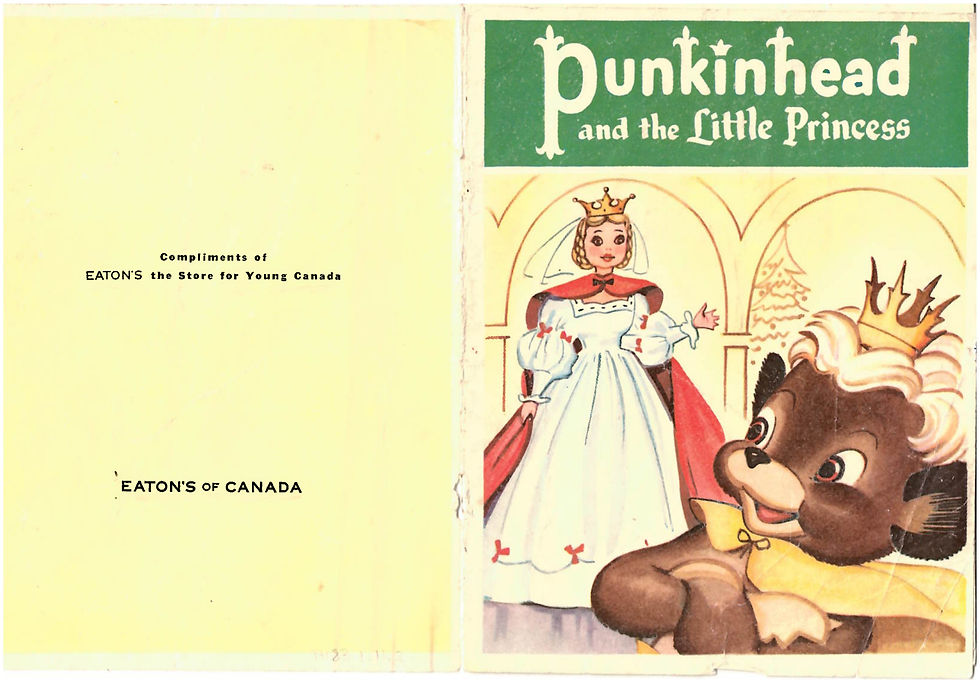
Although there was immense success, Charles Thorson had the tendency to let his temper get in the way, as in the case of Punkinhead it could have allowed him to retire with some royalties. In 1949 Thorson sold Eaton’s the rights to the character for $1.00, and sometime later as stated in Gene Walz’s book entitled, Cartoon Charlie: The Life and Art of Animation Pioneer Charles Thorson, he was acting disorderly during a work event at the Fort Garry Hotel, had gotten into an argument with an executive and was fired after throwing a punch. To this day, it is unclear as to who it was.
Charles Thorson in the Transcona Museum Collections
The connection between the Transcona Museum and Charles Thorson is through the hand drawn cards he gave to his friends every holiday. There was once speculation by word of mouth that someone thought he knew someone in the area or lived here himself. However, after weeks of combing through our archives, Ancestry.ca, newspapers and articles, voting lists, census, and city directories, it all led back to the conclusion that he spent his life living in the West End of Winnipeg.


The holiday cards were donated to the Transcona Museum in March 1974, the information given to the museum by the donor stated that the cards were given to his father, a friend of Thorson, during the 1920s-1930s. A time when Charles worked for Brigdens of Winnipeg, a graphic design firm in Winnipeg.
While certain that Charles Thorson never lived in Transcona, the sheer fact that we have some of his drawings in the collection is astonishing at best.


Overall, Charles Thorson’s legacy is one that allows a multi-generational outlook, as it gives all ages a chance to reflect, appreciate, and connect to the nostalgic characters and moments that Charles Thorson helped to create.
Sources:
Bernhardt, Darren. “From Snow White to Bugs Bunny: Gimli Cottage Was Childhood Home to Artist Who Shaped Cartoon History | CBC News.” CBC news, July 8, 2018. https://www.cbc.ca/news/canada/manitoba/gimli-home-cartoonist-charles-thorson-snow-white-bugs-bunny-1.4734882.
Bernhardt, Darren. “When Winnipeg-Created Punkinhead Made Canadian Retail History for Eaton’s | CBC News.” CBC news, December 27, 2020. https://www.cbc.ca/news/canada/manitoba/punkinhead-bear-cub-eatons-christmas-winnipeg-1.5840477.
Census of the Prairie Provinces,1901. Library and Archives Canada
Census of the Prairie Provinces,1931. Library and Archives Canada
Charlie Fonds, University of Manitoba Archives
Gaudet, Matt. “Charles Thorson.” Icelandic National League of North America, December 27, 2020. https://inlofna.org/biographies/charles-thorson.
Goldsborough, Gordon. “Historic Sites of Manitoba: Eaton’s Department Store (320 Portage Avenue, Winnipeg) .” Historic sites of manitoba: Eaton’s Department Store (320 Portage Avenue, Winnipeg), May 12, 2025. https://www.mhs.mb.ca/docs/sites/eatons.shtml.
Goldsborough, Gordon. “Historic Sites of Manitoba: Timothy Eaton Statue (320 Portage Avenue, Winnipeg) .” Historic sites of manitoba: Timothy Eaton Statue (320 Portage Avenue, Winnipeg), April 29, 2024. https://mhs.mb.ca/docs/sites/eatonstatue.shtml.
Goldsborough, Gordon. Memorable Manitobans: Stefan Thorson (1858-1934), April 18,2020. https://mhs.mb.ca/docs/people/thorson_s.shtml.
Henderson’s Winnipeg Directory. Canada: Henderson Directories Limited, 1908. Peel’s
Prairie Provinces, University of Alberta Libraries.
Gourluck, Russ. A store like no other: Eaton’s of Winnipeg. Winnipeg: Great Plains Publications, 2008. https://canadianaci.ca/Encyclopedia/punkinhead/.
Henderson’s Winnipeg Directory. Canada: Henderson Directories Limited, 1911. Peel’s Prairie Provinces, University of Alberta Libraries.
Henderson’s Winnipeg Directory. Canada: Henderson Directories Limited, 1912. Peel’s Prairie Provinces, University of Alberta Libraries.
Henderson’s Winnipeg Directory. Canada: Henderson Directories Limited, 1914. Peel’s Prairie Provinces, University of Alberta Libraries.
Henderson’s Winnipeg Directory. Canada: Henderson Directories Limited, 1923. Peel’s Prairie Provinces, University of Alberta Libraries.
Henderson’s Winnipeg Directory. Canada: Henderson Directories Limited, 1924. Peel’s Prairie Provinces, University of Alberta Libraries.
Henderson’s Winnipeg Directory. Canada: Henderson Directories Limited, 1926. Peel’s Prairie Provinces, University of Alberta Libraries.
Henderson’s Winnipeg Directory. Canada: Henderson Directories Limited, 1928. Peel’s Prairie Provinces, University of Alberta Libraries.
Henderson’s Winnipeg Directory. Canada: Henderson Directories Limited, 1930. Peel’s Prairie Provinces, University of Alberta Libraries.
Henderson’s Winnipeg Directory. Canada: Henderson Directories Limited, 1933. Peel’s Prairie Provinces, University of Alberta Libraries. https://archive.org/details/P000921-4-14/page/n1097/mode/2up.
Henderson’s Winnipeg Directory. Canada: Henderson Directories Limited, 1948. Peel’s Prairie Provinces, University of Alberta Libraries.
Henderson’s Winnipeg Directory. Canada: Henderson Directories Limited, 1951. Peel’s Prairie Provinces, University of Alberta Libraries.
Henderson’s Winnipeg Directory. Canada: Henderson Directories Limited, 1952. Peel’s Prairie Provinces, University of Alberta Libraries.
Knudde, Kjell. “Charles Thorson.” lambiek.net, January 1, 1970. https://www.lambiek.net/artists/t/thorson_charles.htm.
“Libguides: Charlie Thorson Fonds: Charlie Thorson Fonds.” Charlie Thorson fonds - Charlie
Thorson fonds - LibGuides at University of Manitoba. Accessed July 23, 2025. https://libguides.lib.umanitoba.ca/c.php?g=542317&p=3715836.
“Punkinhead.” Canadian animation, cartooning and Illustration. Accessed July 23, 2025.
Walz, Eugene. “Charles Gustav Thorson | the Canadian Encyclopedia.” Charles Gustav Thorson, The Canadian Encyclopedia, 16 June 2008,
Richards, A.G (Jerry). “Dr Stephen Charles Thorson 1925-2005.” British Columbia Medical Journal, April 6, 2018. https://bcmj.org/obituaries/dr-stephen-charles-thorson-1925-2005.


Comments